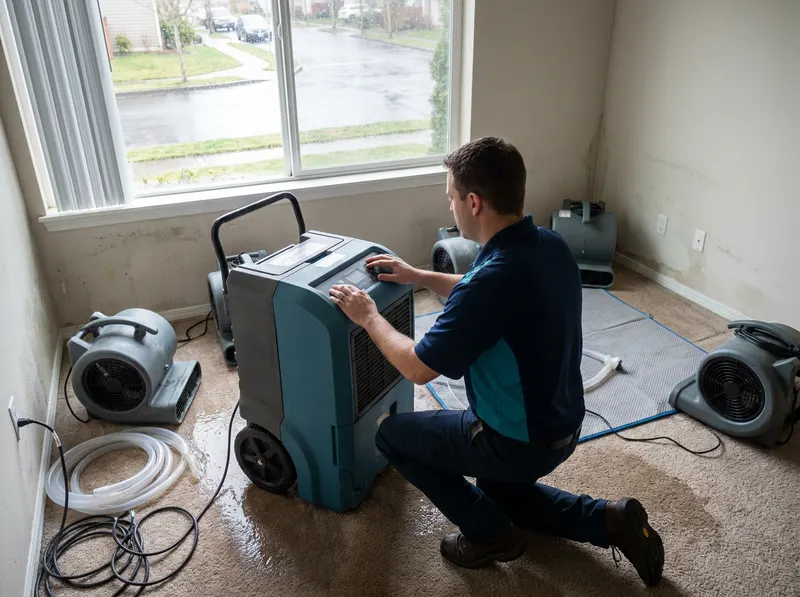
Structural drying follows water extraction and precedes any rebuild. After standing water is removed, materials like Douglas fir framing, OSB subfloor, and drywall still hold bound moisture that a wet-vac cannot reach. Air movers push a high-velocity air layer across surfaces to accelerate evaporation, while a dehumidifier pulls that moisture out of the air so it does not simply reabsorb into nearby materials. In Seattle's damp climate, average relative humidity sits near 75% and the city records roughly 150 rainy days a year, passive air-drying alone rarely brings a wall cavity below the mold-growth threshold, so mechanical dehumidification does the actual work.
Equipment selection depends on the assembly. Low-grain-refrigerant (LGR) dehumidifiers suit most heated Seattle homes and remove water efficiently at normal indoor temperatures. Desiccant units are chosen for cold crawlspaces, dense hardwood floors, and older Capitol Hill or Queen Anne homes with lath-and-plaster walls that dry slowly. A typical single-room job runs 2 to 4 air movers and 1 dehumidifier; a flooded basement in Ballard or a whole main floor may need 8 to 12 air movers and 2 to 3 dehumidifiers. The count and runtime set most of the price.
Drying is measured, not guessed. A moisture meter reads the material each day, and readings are logged against an unaffected reference area of the same material, the drying standard used across the restoration industry. If a maple floor in a Fremont bungalow reads 12% while a dry reference board reads 8%, the equipment stays until the affected wood matches the reference. Cavity drying often uses injectidry systems that force air behind baseboards and into wall bases, avoiding the need to open drywall. This is where the decision fit matters: if moisture is caught within 24 to 48 hours and readings trend down, in-place drying saves the drywall and flooring; if materials stay saturated past that window, or a moisture meter flags trapped water behind a vapor barrier, controlled removal of that section dries faster and prevents hidden mold, a call made on-site from the meter data, not upsold blindly.
Crawlspace drying is common in Seattle's older housing stock, where post-and-pier foundations in neighborhoods like Wallingford and West Seattle trap humidity. Ground-source moisture and poor ventilation mean a crawlspace can hold saturated joists for weeks after a pipe leak; desiccant drying with a vapor barrier check is the usual approach there. Same-day equipment placement is available most days; documentation is provided in a format insurers accept for a claim.