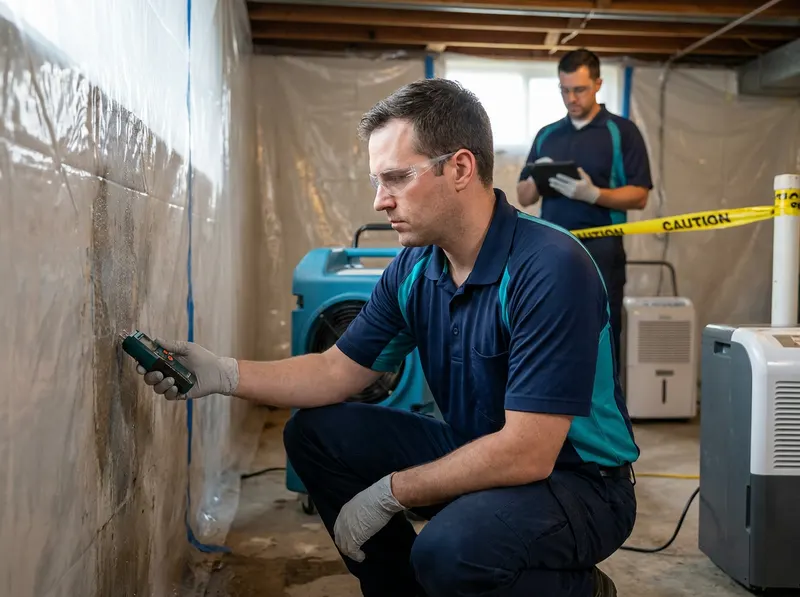
Puget Sound Clean Air Agency and Washington Administrative Code 296-62 govern asbestos work in Seattle, and both require friable material to be identified before it is disturbed during a water damage job. When a burst supply line soaks a 1962 Wallingford basement or a roof leak stains a Beacon Hill popcorn ceiling, the wet material often has to be removed, but demolition on anything suspect stops until a lab confirms whether asbestos is present. Coordination bridges that gap so a homeowner isn't left managing separate testing labs, abatement crews, and drying schedules alone.
The sequence is straightforward. First, suspect materials, pre-1980 floor tile, drywall mud, vermiculite attic insulation, and pipe lagging are the usual finds in Ravenna, Georgetown, and older Ballard housing stock, are left undisturbed. Second, an accredited inspector collects bulk samples for lab analysis, with results back in one to three days. Third, if a sample tests above 1% asbestos, a Washington-licensed abatement contractor sets up negative-air containment and removes the material under permit. Fourth, an air clearance test confirms the space is safe. Only then does structural drying, cleaning, and rebuild resume.
Coordination fits any water loss in a home built before the mid-1980s where saturated demolition is unavoidable. A single soaked room with modern gypsum board and no popcorn ceiling rarely needs it; a flooded 1950s Green Lake kitchen with original sheet flooring almost always does. The trade-off is time, waiting on sample results adds one to three days before drying can finish, but disturbing asbestos without testing violates state rules, risks fibers spreading through wet HVAC returns, and can trigger a stop-work order. Because King County's older neighborhoods carry a high share of pre-1980 construction, this step is common on Seattle water losses rather than rare.
Asbestos abatement coordination is not the same as asbestos removal itself: the removal is performed by a separately licensed contractor, and coordination is the scheduling, oversight, and clearance layer that keeps testing, abatement, and restoration in the right order. Homeowners often ask about insurance, asbestos testing and abatement tied to a covered water loss is frequently included in a claim, and documentation from the coordination step supports that filing. Call to walk through the affected area; texting a photo of the damaged material and stating the home's build year helps flag risk before demolition begins.